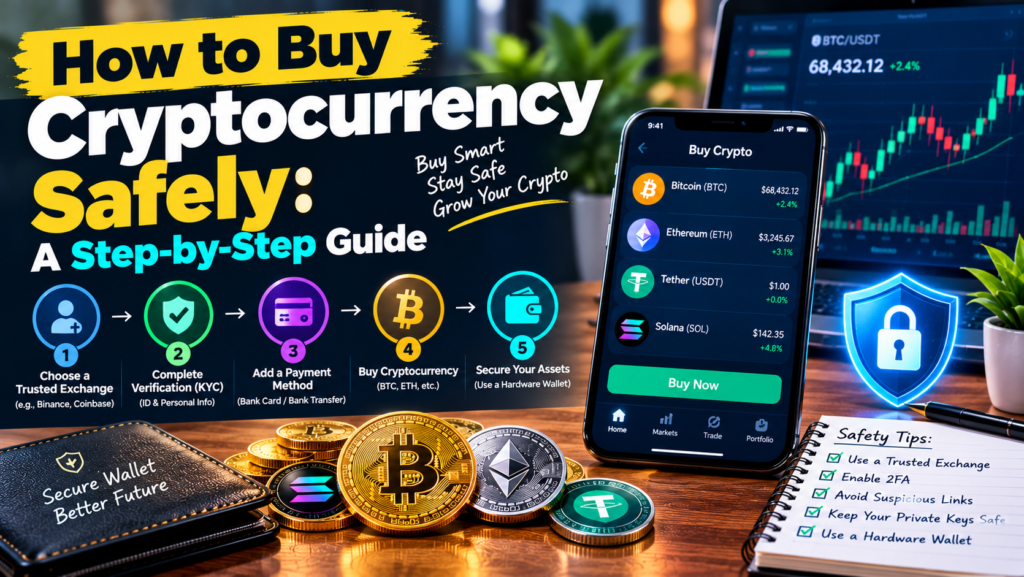

Illustrative image. Review image licensing and availability before publishing.
Buying cryptocurrency involves more than pressing a purchase button. You need to understand the platform, fees, custody arrangements, and possibility of losing money. Availability and legal requirements vary by country, so verify current local rules before opening an account or transferring funds.
1. Learn the Basics First
Understand the asset you are considering, how its network works, and what risks it carries. Be wary of claims that a token is guaranteed to rise or that an opportunity is available only for a few minutes. High-pressure sales tactics are a common warning sign.
2. Research the Platform
Check whether the exchange or service is authorized to operate in your jurisdiction. Review its fee schedule, deposit and withdrawal methods, customer support, security features, and withdrawal restrictions. Search for credible reporting about outages or security incidents. Do not rely solely on advertisements or testimonials.
3. Secure Your Account
Use a unique password stored in a reputable password manager and enable two-factor authentication, preferably with an authenticator app or security key where supported. Protect your email account as well, because it may be used to reset exchange access. Never share verification codes with callers or messages claiming to be support.
4. Understand Wallet Choices
With a custodial service, the provider controls the private keys. With a self-custody wallet, you control the keys and are responsible for recovery. Keep recovery phrases offline in a secure place. Anyone who obtains your phrase may be able to take your assets, and support staff should never need it.
5. Check Every Transaction
Confirm the asset, network, destination address, and fees before sending. Similar-looking networks or tokens may not be interchangeable. Consider a small test transfer when appropriate, and remember that a test transaction does not guarantee every future transaction will be safe.
6. Keep Records and Manage Risk
Save transaction records and understand any tax reporting obligations. Avoid borrowing to buy volatile assets, and never invest money needed for essential expenses. Consider the possibility of platform failure, technical problems, and rapid price declines.
Warning Signs of a Scam
- Guaranteed returns or “risk-free” profits.
- Requests for your seed phrase, password, or verification code.
- Unexpected links or fake support accounts.
- Pressure to send crypto immediately to unlock a prize or withdrawal.
Conclusion
There is no completely risk-free way to buy cryptocurrency. Research carefully, use strong security practices, and check official local guidance. This article is educational and does not provide financial or legal advice.
Expanded Article
This longer version provides additional context, practical steps, and common questions for readers who are new to the topic. Cryptocurrency markets and technologies involve substantial uncertainty; use this material for education rather than as personalised investment advice.
Choose a platform carefully
Check whether the exchange operates where you live, what fees apply, how withdrawals work, and what security controls are available. Use the official domain or verified application listing, and beware of sponsored links or lookalike websites. A small initial purchase can help you understand the process without exposing a large amount.
Verify every transfer
Confirm the asset ticker, destination address, blockchain network, and total fee before sending. For a new address, a small test transfer may reduce the risk of a costly mistake, though it adds fees. Copy-and-paste malware can replace wallet addresses, so verify the destination carefully on the device used to approve the transaction.
Practical considerations
Before taking action, define your goal and understand the trade-offs. Cryptocurrency products differ in design, reliability, liquidity, fees, and legal treatment. A popular project is not automatically suitable for every person, and past performance does not establish future results. Read original documentation and compare claims against independent evidence instead of relying only on promotional posts.
Security and personal responsibility
Use unique passwords, multi-factor authentication, and official websites or applications. Never share a private key or recovery phrase with anyone. Be wary of urgent messages, guaranteed returns, and requests to send funds to unlock a prize or recover an account. Transactions on public blockchains are often irreversible, so verify addresses, networks, and fees before confirming.
Costs, taxes, and records
Costs can include platform commissions, spreads, withdrawal fees, and network transaction fees. Keep records of purchases, sales, transfers, and fees, and check the tax rules that apply in your jurisdiction. Rules and platform availability can differ by country and change over time. For complex financial or tax decisions, consult a qualified professional who understands your circumstances.
A checklist before deciding
Ask what problem the product solves, who uses it, how it is secured, how it is governed, and what could make it fail. Look for transparent documentation, realistic claims, independent security reviews, and a clear explanation of the risks. If you cannot explain the product in plain language, take more time to learn before committing money.
Frequently asked questions
Can research eliminate risk? No. Research can help identify warning signs, but it cannot eliminate market volatility, software failures, fraud, regulation changes, or platform problems. Is crypto suitable for everyone? No. It is possible to learn about blockchain without buying digital assets. The right decision depends on your financial position, risk tolerance, and goals.
Conclusion
The most useful approach is to learn gradually, keep expectations realistic, and avoid decisions made under pressure. Focus on understanding the technology and protecting yourself rather than chasing short-term price predictions. This article is for educational purposes only and is not personalised financial, investment, or tax advice.